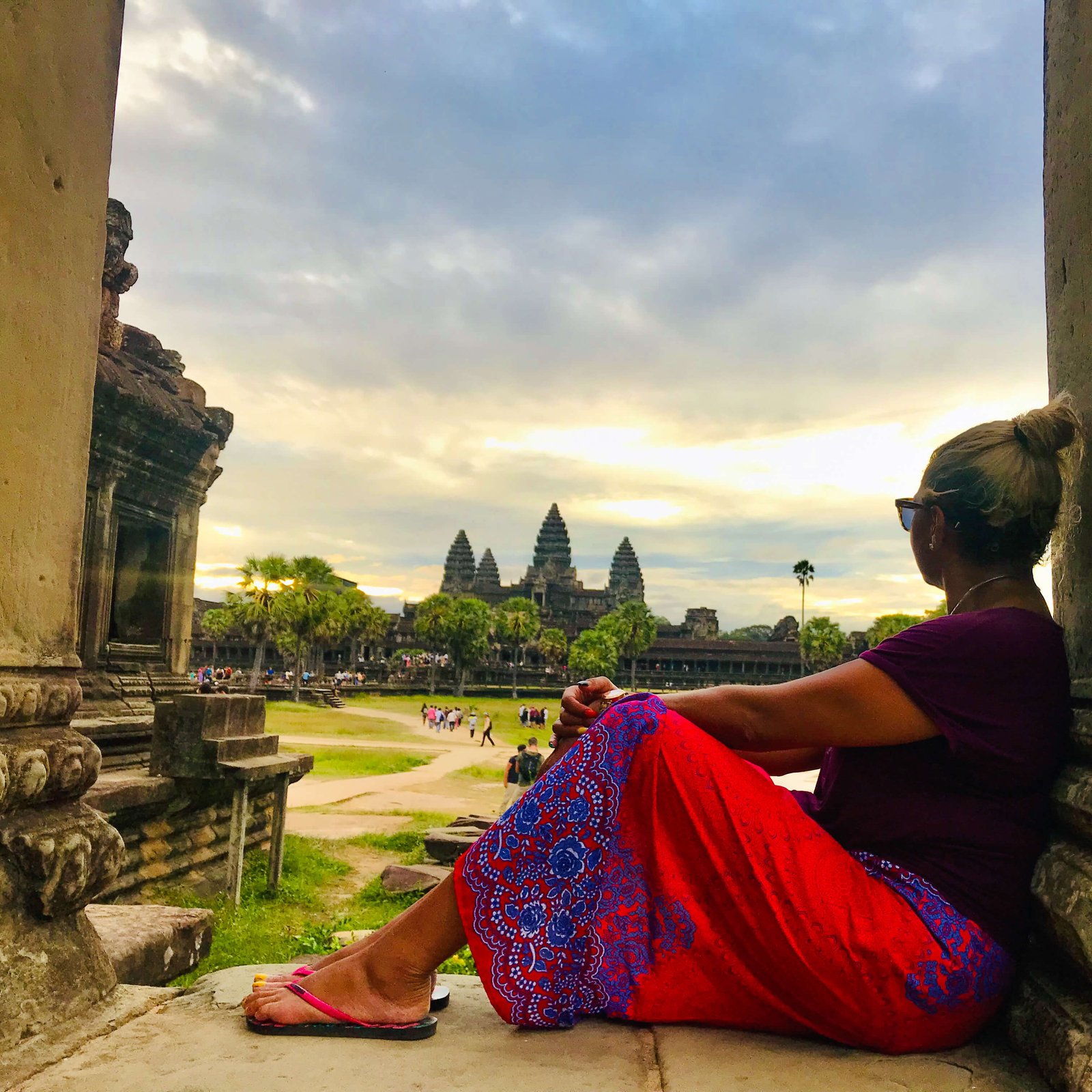
There are places you visit and places that visit you. Angkor Wat, the great Khmer temple complex in Siem Reap, is firmly in the second category.
I arrived in the dark, long before the guided tours, and found a spot in the outer gallery to sit — back against a stone column worn smooth by centuries of hands, looking out across the reflecting pool toward the five towers. The sky turned apricot, then gold, then something that doesn't have a name. I sat for a long time and thought about very little.
"Away from the central towers, in the outer galleries, there are moments of extraordinary quiet. Just the sound of birds and distant bells."
The Weight of Angkor
Angkor Wat was built in the 12th century under King Suryavarman II — the largest religious monument ever constructed by human hands. It covers nearly 400 acres and at its height was home to a city of close to a million people, at a time when London had perhaps 50,000. To walk its galleries is to understand, in the bones rather than the head, what civilisation can do when it commits fully to an idea.
What doesn't appear in photographs is the silence. Away from the central towers, in the outer galleries where the devata carvings line the walls — hundreds of celestial dancers, each slightly different, carved into the sandstone with a precision that has survived eight hundred years — there are moments of extraordinary quiet. Just the sound of birds and distant bells and the wind moving through the palms beyond the moat.
The carvings are the detail most people rush past to reach the towers. Spend time with them. Each devata is an individual — different headdresses, different postures, different expressions. The Khmer artists who made them were not producing decoration. They were recording a vision of the divine in the only medium that would last.
Going Before the Crowds
The standard Angkor Wat experience involves arriving at dawn with several thousand other people to photograph the temple's reflection in the pool. It is still beautiful — the image is as iconic as it is for a reason. But it is not the experience of the place.
For that, you need to be there later, after the dawn-chasers have moved on, and before the midday tour groups arrive. Roughly 9am to 11am, the temple has a brief window of relative calm. The light by then is direct and less photogenic, but the space is navigable. You can sit in the galleries alone. You can walk the causeway slowly. You can find the corner in the northeast quadrant where the acoustics are strange and the walls seem to breathe.
I've visited three times now. Each time Angkor takes more from you and gives more back. It is not a comfortable place — the scale is inhuman, the history is heavy, the heat by midday is serious. But it is one of the handful of places on earth that justifies the phrase "once in a lifetime" without irony.
Planning Notes
Getting there: Fly into Siem Reap. Well connected from Bangkok, Singapore, Kuala Lumpur and Ho Chi Minh City. A three-day Angkor pass (USD 62) covers the main complex and outer temples.
When to go: November to February for cooler, drier weather. Avoid April — peak heat and the Khmer New Year period.
Getting around: Hire a tuk-tuk driver for the full day. A good driver will suggest the sequence, know the quieter hours at each temple, and wait patiently. Budget USD 25–35 for the day.
The three-temple circuit: Angkor Wat for the scale and the carvings. Bayon for the stone faces — unsettling and extraordinary. Ta Prohm for the trees growing through the walls. Allow a full day minimum.
Stay: Amansara — the definitive Siem Reap hotel, 24 suites, pool, and private Angkor access arrangements. Alternatively, Shinta Mani Wild for something further afield and genuinely extraordinary.
One final thought. Angkor is sometimes listed alongside the pyramids or Machu Picchu as one of those monuments you should see before you die. That framing makes it sound like an obligation. It isn't. It's an invitation — to sit quietly in front of something eight hundred years old and notice what it does to your sense of time. That's worth the flight from anywhere.